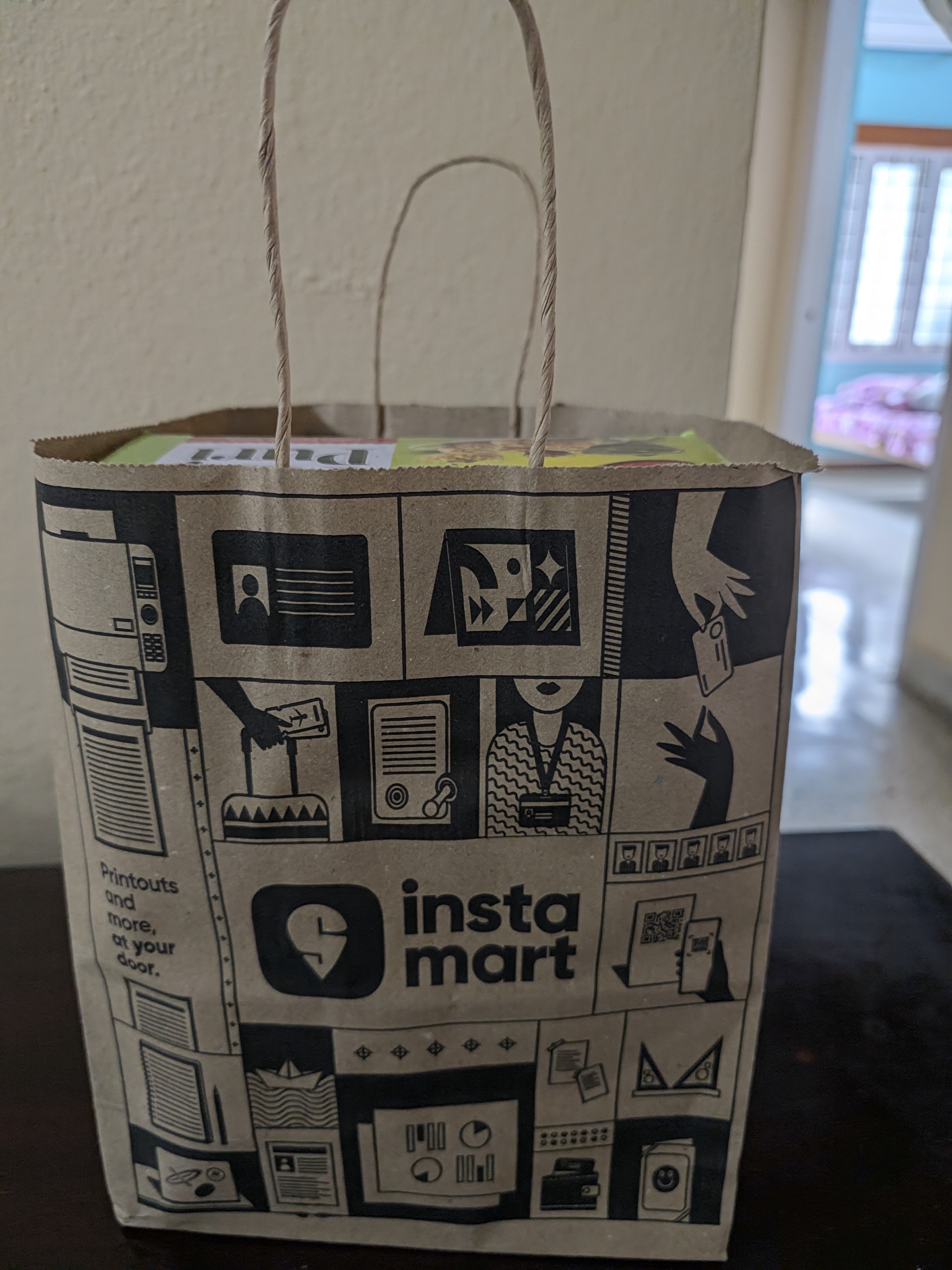
Eleven minutes. That is how long it took, this summer in Ameerpet, for a pair of pajama pants to travel from a dark store I couldn't see to the gate of the house I grew up visiting. I hadn't ordered milk or bread, the things you expect from a fast delivery app. I ordered something almost absurd on purpose, just to see what the boundary was. There wasn't one. The rider was there before I'd finished my coffee.
I keep thinking about the phone we had on the wall of our house in Hyderabad, the one with the long cord that let you carry it halfway across the room while you talked. That was how we ordered groceries too, in a way. You called the Kirana store down the street, a shop that knew your family's tea brand and how much sugar my mom liked, and you read out a list from memory. No app, no cart, no notification. Half an hour later, an errand boy showed up with everything wrapped in newspaper and cloth bags, and a bill written out by hand in pencil, the numbers added up in the margin. That was quick commerce too, just slower, and warmer, and it had a name and a face attached to it.
From the Kirana speed dial to the dark store
The shops themselves are mostly gone now. Around Ameerpet, where I remember three supermarkets competing for the same short stretch of road, there is one Ratnadeep left standing. The street vendors who used to call out the names of vegetables in season, moving through the lanes on their own private schedule, still come, but rarely, and it feels more like a memory of themselves than the thing itself. Something has been hollowed out of the block, and something else has filled the space, invisibly, behind shutters that show no sign or face to the street. Just doors, and bikes parked outside them, and a constant hum of two-wheelers pulling in and out.
My mom knew the boy who delivered her groceries. He knew her by name too. I will likely never know who dropped off my pajama pants, and neither will they know me beyond a pin on a map.
What struck me during that week wasn't the speed exactly. It was how quickly the speed stopped feeling remarkable. By the third day I wasn't testing the app anymore, I was just living inside it. A forgotten charger adapter. A specific brand of pickle my aunt asked for. And then, one afternoon, purple toothpaste. I have a small, admittedly strange fascination with toothpaste colors, having tried green, yellow, white, red, and transparent over the years, and when I saw a purple tube in the app I couldn't resist. None of it required leaving the house, or even really planning ahead. Three taps and a wait shorter than a phone call used to take. The only thing that reminded me this was still India, still a place with its own rhythms, was trying to order coffee before six in the morning and finding the dark stores hadn't opened yet either. Even algorithms keep something like local hours.
The scale behind the eleven minutes
What I experienced on one street in Ameerpet is happening at a size that's hard to picture from inside it. Here is what sits behind the eleven minutes:
Market velocity: India's quick commerce sector reached an annualized gross merchandise value of roughly $7 billion to $8 billion in 2026, up from under $1 billion in 2020, with projections toward $30 billion to $40 billion by 2030.
Daily frequency: Blinkit, Zepto, and Swiggy Instamart together process an estimated 7 million to 8 million orders every day.
Micro-fulfillment footprint: More than 6,000 dark stores now operate across Indian metros, each positioned within a 2-to-3-kilometer radius to guarantee sub-15-minute dispatch.
Consumer base: Monthly transacting users have climbed past 50 million to 60 million, turning what began as an emergency top-up service into a primary retail channel.
I don't think the Kirana store and the dark store are really opposites, even though it's tempting to frame it that way, nostalgia against convenience, the handwritten bill against the push notification. They are doing the same job. Somebody, somewhere, is making sure a stranger's list of small needs gets fulfilled quickly, without the stranger having to leave home. What changed is who that somebody is, and whether you will ever know their name.
I keep going back to that image of the high street I grew up walking, not because I think it can or should come back, but because it tells you something about what a neighborhood used to be built on. It was built on recognition. On the shopkeeper remembering your order. On the vendor who saved you the good tomatoes because he'd known my mom for twenty years. What has replaced it is faster, and probably fairer in some ways, and certainly more efficient. But it is also quieter, in a way that has nothing to do with noise. The high street didn't slow down and disappear. It moved indoors, behind unmarked doors, into screens we carry in our pockets. It's still there. It just doesn't know your name anymore.
If you've watched your own neighborhood change shape this fast, I'd like to hear about it. Leave a comment below or find me on LinkedIn, I'm always looking for the next street corner that's quietly disappeared.

The Cellular Jail in Port Blair has a long corridor of cells, each one built so prisoners could not see one another, radiating out from a central tower like spokes. Near the entrance there is a list. Names, home provinces, sentences. I stood there scanning it the way you scan any list looking for your own reflection, and what I found instead was an absence. Bengal, over and over. Punjab, again and again. Bihar, Uttar Pradesh, a scattering from Odisha. Kerala showed up here and there. Tamil Nadu wasn't even broken out on its own, folded into a leftover category with a few other states. Out of 585 revolutionaries sent to that prison between 1909 and 1938, 398 came from undivided Bengal. I did the math standing right there in the corridor, and it bothered me enough that I have been chasing the answer ever since, including now, back in Hyderabad, the city that gave me my first Ghadar footnote and, I am beginning to think, quite a few others.
A List With Gaps
The South fought too, in some cases earlier than the North did. The Poligar wars against the East India Company in the late 1700s. The Vellore mutiny in 1806, decades before 1857. The Rampa Rebellion in the Godavari hills in the 1920s, and the Malabar rebellion not long after. None of it looked like Bengal or Punjab, organized nationalist politics with newspapers and a party structure and a paper trail of arrests. It looked like armed uprisings by local rulers and hill communities, scattered across a century instead of concentrated in one dramatic decade, and that is a much harder story to fit into a single textbook chapter. So it mostly didn't make it into mine.
A Kingdom That Wasn't Under the British
My own family never lived under the British at all. We were subjects of the Nizam of Hyderabad, one of the princely states that sat technically outside the Raj, ruled instead by a king whose loyalty and language and law were entirely his own. My family described hiding from the Razakars, the Nizam's private militia, in the chaotic year before Hyderabad was folded into independent India in September 1948, more than a year after the British had already left.
Independence for my family didn't arrive with the British departure. It arrived later, and it felt, by their account, closer to an invasion than a handover.
Tanks and infantry sent by Delhi to finish what 1947 had left unfinished. That story does not fit cleanly into a textbook chapter titled The Freedom Struggle, so it simply isn't in one.
Pondicherry's Borrowed Freedom
And yet the South was never absent from resistance, only absent from the record. Pondicherry, a French enclave surrounded on all sides by British India, gave shelter to Tamil revolutionaries the same way Switzerland gave shelter to political refugees in Europe. The poet Subramania Bharati fled there in 1908 when the British were closing in on him for his writing, and it was in Pondicherry, not British Madras, that he wrote his best work over the next decade, hosting the exiled Bengali revolutionary Aurobindo Ghosh, watched over the whole time by French administrators who simply told the British no when they came asking. It is one of the stranger ironies of the freedom movement that a French colonial administration gave a Tamil poet the legal cover that British Madras would not. Tamil readers and patrons kept him fed and published the entire time he was there. It was the government across an invisible colonial line he needed protection from, not his own people.
A Kingdom That Reached the Ganges
I think about the Chola kings sometimes too, because the South's absence from the story isn't only about the twentieth century. Rajendra Chola sent an army all the way to the banks of the Ganges in the eleventh century and beat a northern king on his own territory, taking the title Gangaikonda Chola for it. He then turned around and sent his navy to Sumatra and the Malay Peninsula and conquered Srivijaya's port cities outright. That conquest sat inside something larger, a Tamil trading network that already reached Arab merchants and, more loosely, the East African coast. The ports in Southeast Asia were taken by force. The wider ocean around them was held by commerce, not war, which somehow makes it more impressive rather than less. This was not a regional kingdom hiding in the south of a subcontinent. That history sits closer to my own childhood than the freedom struggle does, and it barely made it into my textbooks either.
Two Memorials, One Far From Home
Subhas Chandra Bose laid the foundation stone for an INA memorial at Esplanade Park in Singapore in July 1945. The British tore it down within weeks of retaking the city. Singapore put a marker back on that same spot in the 1990s. India has its own INA memorial too, at Moirang in Manipur, on the ground where the INA first raised its flag on Indian soil in 1944. I had heard of the Singapore memorial. I had never heard of Moirang, which is its own kind of far away, tucked into a corner of the country most Indians will never visit. Maybe that is the real pattern, not that the South was written out of the story on purpose, but that the story was always written from one place, looking outward, and everything at the edges got smaller the further it sat from the center. I don't know if that is better or worse than deliberate erasure. I only know that I had to leave the country, and now come back to a corner of it, to go looking for the parts my own schooling never gave me.
If your own region's history got the footnote treatment growing up, I'd like to hear which part of the story went missing for you.

I am writing this from Hyderabad, on vacation, in the same city where I first read about the Ghadar movement in one paragraph of a school textbook and moved on without a second thought. Decades later, back here again, I watched The Revolutionaries on Amazon Prime and felt that particular jolt of recognizing a name you were taught once and never actually learned.
So I went looking, the way you do now, one search leading to another until I was reading a 1906 pamphlet titled British Rule in India, written by William Jennings Bryan, the man who would later serve as U.S. Secretary of State, wondering why he had been writing about the Raj at all years before that job existed for him. Bryan had visited India in 1906 as part of a world tour, and what he wrote became useful to people he probably never imagined reading him. Indian revolutionaries in San Francisco reprinted his words nearly a decade later as ammunition against the very government he was describing.
A Building on Hill Street
That pamphlet came out of a building at 436 Hill Street, a modest San Francisco address that called itself Yugantar Ashram, abode of the new era. This was the headquarters of the Ghadar Party, founded in 1913 by Punjabi immigrants, many of them Berkeley students, who had come to the United States for work and found something else waiting for them here, the particular clarity that comes from being discriminated against in a country that claims to be free while your own country isn't free at all. Sohan Singh Bhakna, one of the party's leaders, put it the way I wish my textbook had. We were not Sikhs or Punjabis. Our religion was patriotism.
The Man Who Left No One Behind
Lala Har Dayal ran the intellectual engine of the whole operation. He'd turned down two Oxford scholarships and a guaranteed post in the Indian Civil Service to do this instead, and the U.S. government arrested him in 1914 for it. He jumped bail, spent the rest of his life drifting through Europe, mostly stateless, and died in Philadelphia in 1939, the night after giving a lecture, reportedly saying he was at peace with all. I went looking for what happened to his family afterward and found almost nothing. He'd married very young, at sixteen, to a woman named Sundar Rani, and then left for Oxford and, by most accounts, never really returned to that marriage. No children that history recorded.
A man who spent his whole life trying to father a free country left no one behind to carry his own name.
Not the Kobayashi Maru
And then there is the Komagata Maru, which I have to say straight away is not the Kobayashi Maru, though I made that exact joke to myself before I looked it up properly. The Komagata Maru was a real ship, carrying hundreds of Indian passengers who were turned away from Vancouver harbor in 1914 under immigration laws designed specifically to keep them out, then sent back toward Calcutta where colonial police were waiting. Twenty of them were killed in the confrontation that followed at Budge Budge. It's the kind of story that should live in every schoolbook that talks about the freedom movement as something that only happened on Indian soil.
Kala Bagai's Door
What stayed with me longest, though, was Kala Bagai. She arrived in Berkeley in 1915 with her husband Vaishno Das and their three sons, and when they tried to move into the house they'd bought, their neighbors stood in the doorway and physically blocked them. In 1923, a Supreme Court ruling stripped South Asians of the citizenship many had already gained, and Vaishno Das, made stateless in a country he'd chosen, took his own life. Kala rebuilt everything from there. She remarried, moved to Southern California, and spent the rest of her life building the kind of welcoming community that had once refused to welcome her, earning the name Mother India along the way. It was her granddaughter, Rani Bagai, who donated that old Bryan pamphlet to an archive in Philadelphia, which is how a document meant to embarrass the British Empire ended up, a century later, embarrassing my own education instead.
I don't know what to do with a footnote once you've pulled on it long enough to find a Punjabi press, a stateless scholar, a wrongly named ship, and a woman who kept building homes in a country that once wouldn't let her walk through the door of her own. I am still in Hyderabad as I write this, in the city where the footnote started, and it turns out the rest of the story was never here. It was on the other side of the world the whole time, waiting for someone to go looking.
If there's a footnote from your own schooling you're still chasing down, tell me about it in the comments. I'd like to hear it.
 Personal Essay | September 12, 2026
Guests Show Up. An Audience Is Designed.
By Shashi Bellamkonda
The Qualtrics XM Analyst event this week was not held in a hotel ballroom. It was held inside the Utah Jazz training center. That is not a cute venue choice. It is the point.
Ryan Smith sat down with Qualtrics CEO Jason Maynard for a fireside chat, then walked us through the building. The chat was useful. The tour is what I keep turning over.
Smith built a company that taught organizations to listen. Then he bought the loudest rooms in Utah. The Jazz. The Mammoth. An arena that used to be called Vivint and is now Delta Center. When he talks about those rooms, he does not talk the way most owners talk. He does not start with wins, luxury tax, or the next media rights cycle. He starts with the people in the seats, and he does not call them customers.
He calls them guests. Then he treats them like an audience.
Those two words are not interchangeable. A guest is someone you let in. A fan is someone who stays through a bad season. An audience is someone you design for. An audience has segments. Families on a Saturday. Business people who will leave at halftime if the Wi-Fi dies. Die-hards who notice if the player tunnel feels cheap. Tourists who will never sit in the same seat twice. Group tickets that arrive already deciding whether the night was worth it.
On the tour, the same instinct showed up in a different room. Behind the games is a stack of data and science around player health and performance. Load. Recovery. Who can go tonight and who needs another day. It is not the romance of the locker room. It is measurement applied to bodies that have to hold up for eighty-two nights, then a playoff run if they are lucky. Watching that system sit next to the guest experience made the whole operation click. The team on the floor, the staff moving people through a building, the logistics of a game night, and the night the ticket buyer thinks they bought are not separate businesses. They are one orchestration.
Smith talks about clothing. About how players enter the building. About cup holders that used to sit by your feet, which is a small humiliation if you have ever tried to hold a drink, a phone, and a child at the same time. About new seats going in on the north side first. About taking back media rights so a family in Ogden is not locked out of a game by a regional sports network they cannot find on the remote.
None of that is basketball. All of it is experience.
I have sat through enough rooms like this to know when a founder is reciting a slide and when he is describing the thing he actually watches. Smith watches the gap. Qualtrics named that gap years ago: the distance between what people expected when they walked in and what they walked out carrying. In software, the gap hides in a survey three days later. In an arena it is public. Eighteen thousand people feel it at once. They tweet it before they reach the parking garage.
That is why the suite invitations on his X account are not a stunt, even when they look like one. "I've got four courtside seats tonight. Who can make it? Tell me why." "I'm hosting eight Mammoth fans in my suite." He is not giving away inventory. He is closing a loop in public. The owner who built the listening company is still collecting stories, still sorting the room into people, still treating a ticket as the start of a night rather than the end of a transaction.
Sports owners who come from finance inherit a balance sheet. Owners who come from media inherit a broadcast. Smith inherited a laboratory. The product he spent twenty years selling was never the survey. It was the permission to take a small, specific moment (a missed flight, a loud speaker, a seat that makes your knees hit the row in front) and treat it as the whole business for a week.
He has said sports are the antithesis of AI. Live. Shared. Unrepeatable. That is true, and it is also why the analogy holds. You cannot simulate the sound of a building when a late three goes in. You can decide whether the person who drove ninety minutes with kids in the back seat can find a restroom, hear the anthem, and leave without hating the city that hosted them. You can also decide whether the athlete who has to play tomorrow night was managed with the same seriousness as the person in row twelve.
The industry still optimizes for the 18,000 who got through the door. Smith keeps talking about the much larger set who never will. The registered fan who lives in another state. The kid in a Junior Jazz jersey who will remember the night longer than the box score. That is an audience, not a gate count.
I keep thinking about two images from the same afternoon. The science around a player's body. The cup holder that used to be in the wrong place. One looks like high performance. The other looks like a detail. Both are the same habit. Find the moment people actually feel. Fix that moment. Do it again. Then line the work up so the team, the staff, and the guest are not fighting three different nights.
Most of us who work in experience talk about journeys as if they were diagrams. Smith bought the journey and now has to live inside it on game night, with his name on the suite and his phone open to people explaining why their wife deserves the seats.
Guests show up. Fans renew. An audience is the group you are willing to design for when no one is keeping score except them.
About Shashi Bellamkonda
Shashi writes personal essays at ReadyThoughts on culture, work, and the small observations that explain larger systems. He also writes analysis at shashi.co and B2B marketing notes at misunderstoodmarketing.com.
Disclaimer: This blog post reflects my personal views only. AI tools may have been used for brevity, structure, or research support. Please independently verify any information before relying on it. This content does not represent the views of my employer, Infotech.com.

Personal Essay
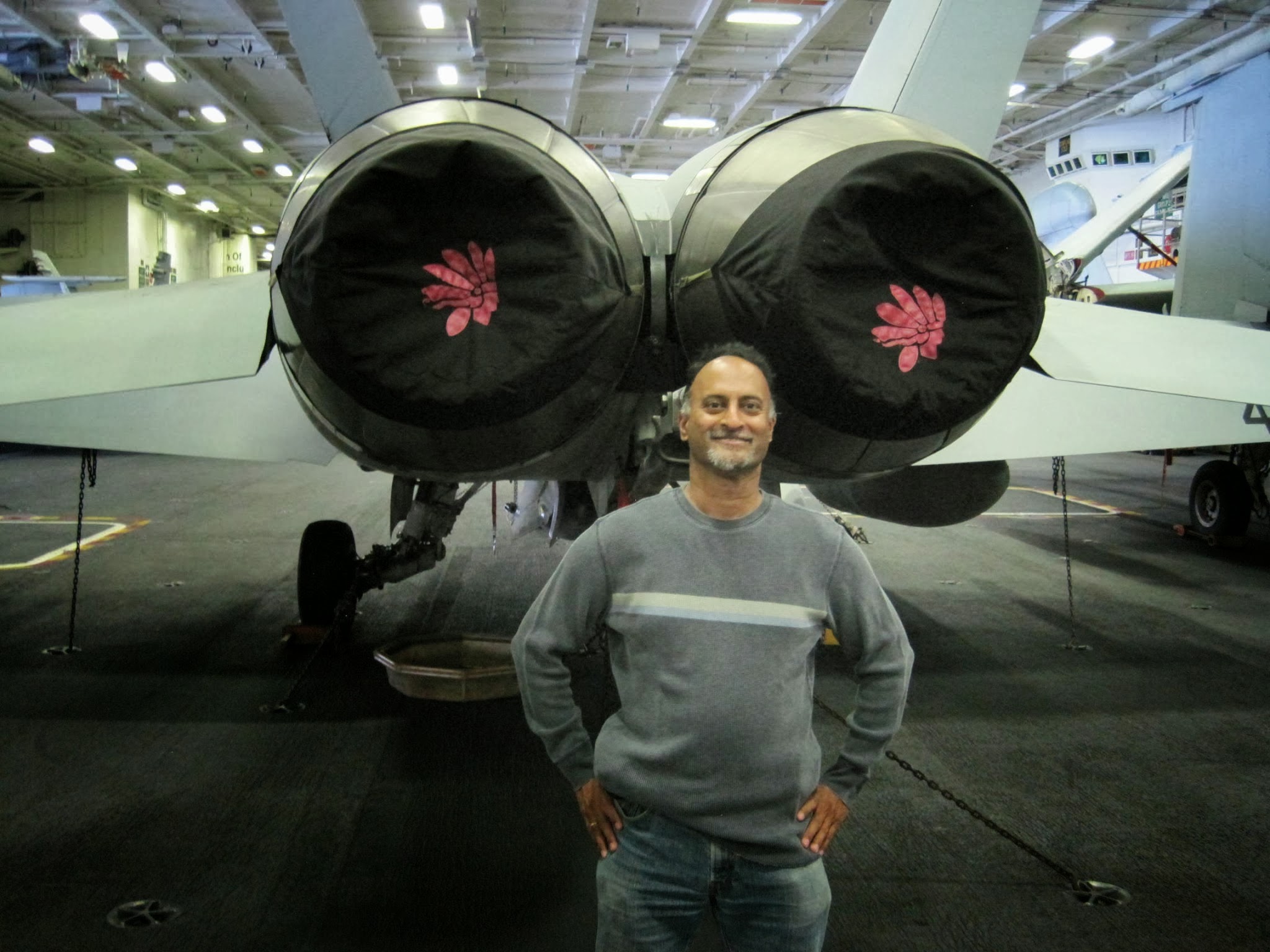
The C-2 had been in the air about an hour when the crew signaled with their hands. Here we go, here we go. I was facing backward, which is not how you expect to land on anything, and the seats were not built for comfort so much as for the fact that every inch of that cabin was already claimed by cargo. Then the deceleration hit, 105 miles an hour to zero in about two seconds, and your whole body registers it before your mind catches up. The tailhook had caught the wire. We had landed on the USS George H.W. Bush.
 This was November 2013, and I was part of the Navy's Distinguished Visitor Embark program, which for twenty four hours turns civilians into guests aboard an aircraft carrier at sea in the Atlantic. When the door opened I remember thinking I had stepped onto the Starship Enterprise. Crew in different colored jerseys moved across the flight deck in a choreography that had clearly been rehearsed thousands of times, yellow shirts and purple shirts and red shirts, each color a job, each job essential to keeping sixty to seventy five aircraft moving without anyone losing a hand or a life.
What stays with me is not the machinery, though the machinery is extraordinary. It is how much of a floating city that ship turned out to be. There is a convenience store called Big Texas, its proceeds funding crew welfare and entertainment. There is a Starbucks inside something called the Lone Star Cafe. There is a library where a chaplain named Peters showed me a program called United to Read, where sailors record themselves reading storybooks so their children back home can hear a parent's voice at bedtime. The ship carries fifteen hundred computer terminals for a crew that runs between forty five hundred and six thousand people, and there is no cell signal, no wifi, nothing. During certain exercises they shut down every electronic device on board just to measure how much the ship emits, and you'd watch the whole crew go quiet like that, by design, on command.
Near the crew galley there was a single table set with one place setting, reserved for POW and MIA service members, a quiet fixture nobody had to explain to me.
The ship's doctor told me about the walking blood bank, sailors who sign up in advance to give blood in an emergency rather than storing it, because storage takes space and space on a carrier is the one thing nobody has enough of.
I thought about all of this recently when I read that the USS Abraham Lincoln had been at sea for nearly nine months. Twenty four hours on the George H.W. Bush was enough to understand that this is a community as much as it is a warship, a small dense city where people work, worship, study for the careers waiting for them after service, and somehow sleep through announcements in the middle of the night because they have learned to. Twenty four hours gave me a glimpse. Nine months is a different thing entirely, and I found myself glad, genuinely glad, that the Lincoln is finally coming home.
To the men and women who serve, on that ship and on every other one, thank you. What I saw in twenty four hours, you live for months at a stretch, and I don't take that lightly.
More Recent Articles
|