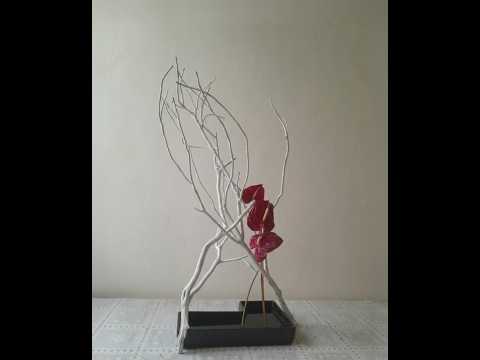
It was Monday, the 6th of July 2026—a warm morning marking the beginning of the week and bringing with it the promise of fresh beginnings. Members of the Chennai Sogetsu Branch were gathered at the ABK Centre after a long summer break, eager to reconnect and plan for the year ahead. The day's demonstrations were presented by Sensei Bhuvana Shivshankaran and member Luna Bose, each bringing their own unique interpretation of the Sogetsu principles. Sensei Bhuvana's first arrangement as a new sensei explored the concept of composing with branches. With remarkable artistry, she intertwined two beautifully sculptural tree branches, allowing them to support one another in perfect balance. The resulting composition reached gracefully upward, evoking a sense of aspiration and quiet strength, as though reaching out towards the sky.  | | Composing with branches--artistry in upward motion (Book 5, Lesson 14) |
Sensei Bhuvana's second arrangement celebrated the characteristics of glass containers, using a blue-green glass vase as an integral design element. She lined the vase with carefully placed leaves and yellow gerberas, transforming it into a visual component of the composition rather than merely a support for the flowers. From this backdrop emerged a single gerbera, accompanied by gracefully arranged foliage and gypsophila. Together, the transparent vessel, the softly coloured water, the leaves, the white gypsophila and the yellow gerberas created a striking sense of space, continuity, and harmony.
 | | Composition celebrating the glass container (Book 5, Lesson 13) |
Sensei Bhuvana's final arrangement was a masterclass in balance, aesthetics, and the expressive power of line. Three bamboo stems were skillfully positioned in a suiban without a kenzan, to form a graceful tripod. Within this carefully defined space, a single yellow gerbera emerged in quiet, solitary beauty. Its simplicity was all the more striking against the geometric structure of the bamboo, demonstrating how restraint and thoughtful placement can create a composition of remarkable elegance and impact.
 | | Composing in a suiban without a kenzan (Book 5, Lesson 8) |
It was then Luna Bose's turn to demonstrate. Her first arrangement explored the Sogetsu principle of disassembling and rearranging materials. She used branches of the Indian borage plant (known as ajwain in Hindi or karpooravalli in Tamil), paired with button chrysanthemums for accent. The composition was beautifully enhanced by the distinctive form of the metal vase, whose sculptural shape complemented the arrangement and added to its overall sense of harmony and elegance.
 | | Finding elemental beauty in disassembling and rearranging plant materials (Book 4, Lesson 9) |
For her second arrangement, Luna used a moribana container (suiban) without a kenzan. She combined branches of the Madagascar almond tree with delicate gypsophila and carnations, creating a composition that was both graceful and balanced. The soft green of the container beautifully complemented the foliage and flowers, enhancing its overall harmony and visual appeal. .jpeg) | | Composing in a suiban without a kenzan (Book 5, Lesson 8) |
The morning was a celebration of creativity and the enduring beauty of Sogetsu ikebana. It also marked a fitting beginning to what promises to be an exciting year for the Chennai Sogetsu Branch, with the 100th Anniversary Sogetsu Exhibition just around the corner in September.
CHENNAI SOGETSU BRANCH ANNUAL EXHIBITION 2025-2026"The Beautiful"With Plant MaterialsThe Chennai Sogetsu Branch began preparation for its annual exhibition in March 2026. This time around, the group decided to have a "virtual" exhibition and 22 members presented their distinctive interpretation of the theme, "The Beautiful," with diverse plant materials.
We hope you enjoy watching the exhibition. Please do leave your comments. Wishing everyone a very happy Tamil New Year!
Art is in nature, nature is in art. And when the two flow together in celebration, the ordinary can indeed transform into poetry. This celebration of life was the focus of the Chennai Sogetsu branch's workshop on January 17th, 2026. 13 branch members came together with much enthusiasm to celebrate the theme of the day.  | Sensei Molly Cherian: Yellow Asia lilies, oncidium ochrid sprays, red canna, white dianthus buds and flowers, gypsophila, wine glasses, and a piece of net in a blue and gold chocolate box as container
|
Sensei Molly Cherian's arrangement seen above was a beautiful celebration of the birth of her great grandson. In her words: As my great grandson 's birthday falls during the month of the Christmas season, I combined the arrangement matching both occasions. Yellow Asia lilies and oncidium orchid sprays were placed in two long-stemmed wine goblets in a blue and gold empty chocolate box, representing the baby boy. For Christmas, red cana flowers, white dianthes buds and flowers, and gypsophila flowers were added along with green leaves. A piece of net was added for vibrancy. Prerana Mehta's arrangement was beautiful in its minimalistic expression. The metal rings of the artistic piece denoted the circle of life, while the blue hues of the bottle represented the birth of a baby boy. The single golden flower represented a child’s golden journey. Riji Sensei Malathi Pandurang chose to interpret the arrangement as a celebration of aloneness.
Prerana Mehta: Blue bottle and golden flower stem in a gold metal piece
Sensei Meenakshi Sarin's arrangement was a celebration of life. A round lantern was used to represent the infinite universe, while the use of monstera leaves and a golden painted heliconia denoted celebration and higher evolution. The yellow chrysanthemums hinted at sunshine - something everyone looks forward to.  | Sensei Meenakshi Sarin: Painted heliconia stem, monstera leaf, yellow spray chrysanthemums,
silver sprayed pine in a green, ceramic container
|
Chelvi Gopinath's arrangement focused on the Pongal harvest celebrated in Chennai recently. The sunflower was used to signify uttarayan - the beginning of the sun's northward journey from the south. The rhizomes - ginger and turmeric - which had recently been harvested, were placed under water to denote their natural place underground. The dry banana leaf connected with the age-old tradition of eating on plantain leaves.
 | Chelvi Gopinath: Sunflower, turmeric and ginger roots, turmeric plant, and dried banana leaf
in a glass container filled with water |
Sensei Ambika Chandrasekar's arrangement celebrated Pongal festivities. She chose a beautiful ceramic container made by artist Sathya Ganapathi, its streaks of white symbolizing streaks of overflowing milk. The upturned sugarcane and turmeric highlighted the roots that exist below ground. The yellow chrysanthemum was chosen to symbolize the sun, the giver of life, and the red anthurium was strategically placed to mark the auspicious kumkum symbol.
Sensei Ambika Chandrasekar: Sugarcane stalks, turmeric roots, chyrsanthemum, anthurium, kallanchoe and limonium flowers in a ceramic container
 | Bhuvana Shivshankaran: Mango leaves and branches, with sunflowers
in a brass kudam (container)
Zeenath Kadir's arrangement hailed the Navarathri festival in its celebratory interpretations of education, new beginnings, and purity.
Zeenath Kadir: Roses, China asters, gerberas, chrysanthemums, jasmine branch, peace lily leaf, and gypsophila flowers in a white container
Shylaja Theetharappan also celebrated Pongal through her use of turmeric and mango leaves. The roots of the turmeric plant signified the earth, while its leaves hinted at the verdant beginnings of spring. The maroon chrysanthemums signified auspicious events. The vase selected stood tall in white purity, even as the green leaves and red flowers emerged in celebration of life.
Shylaja Theetharappan: Turmeric leaves and roots, mango leaves, and crimson chrysanthemum flowers in a white container Gnanambikai Karthikeyan used the color red in her arrangement with shampoo ginger, focusing on its connotations of hope, positivity, fortune, prosperity, and energy. She added a sunflower for brightness, much like the sun crowns our days with shining brilliance.
Gnanambikai Karthikeyan: Shampoo ginger and sunflower in a red, ceramic container
Krishna Ramachandran used the concept of flowers as a celebration of sacrifice and offering to the divine. His ensemble of brass uralis and lamps gave a lovely South Indian touch to the arrangement.
Krishna Ramachandran: Hibiscus flowers, brass diyas and lamps in brass plates and an urali
Susan Sudhir focused on Pongal and used sugarcane to signify the sweetness of life and resilience, yellow chrysanthemums to celebrate the vibrant beauty of life, and white chrysanthemums to remind one of earth's bountiful fullness. She used the earthenware pots (a Pongal festival specialty) to symbolize the ritual of boiling milk and cooking the traditional pongal rice dishes. She also arranged sugarcane stalks to resemble a wooden stove.
Susan Sudhir: Yellow and white chrysanthemums and sugarcane stalks
in earthenware pots Mohan Vummidi chose a variety of chrysanthemum flowers, a bright red and yellow heliconia stem, and a slanting upright dracaena stalk to celebrate color and vibrancy in life.
|
Mohan Vummidi: Dracaena reflexa, heliconia, and chrysanthemums in a tall ceramic container
|
The December 13th workshop of the Chennai Sogetsu branch was a grand finale to the year 2025, and was attended by 13 members. The theme was an extension of the November workshop on Principles 39 and 44, only this time there were no demos by senseis. The floor was left open to the members to practise their interpretation of the two principles. To reiterate the principles: Principle No. 39: "Ikebana must appear as if it is a product of the environment in which it is displayed." Principle No. 44: "Be sure to make definite points of emphases and avoid redundancy in the arrangement." The workshop and the resulting arrangements were a testament to the members' talents.
 | Arrangement by Sensei Trishala Vaishnav
Theme: Principle No. 44 Materials: Dracaena branch and gerbera in a ceramic Pondicherry vase |
 | Arrangement by Sensei Chitra Thiagarajan
Theme: Principle No. 44
Materials used: Umbrella plant, caladium, and purple hearts in a ceramic nageire container |
 | Arrangement by Sensei Ambika Chandrasekar
Theme: Principle No. 39 Materials: Matthiola stalks, pink asters, and anthurium leaves in a basket
Arrangement by Sensei Ambika Chandrasekar
Theme: Principle No. 44 Materials: Costus branch, aglaonema leaves, and asters in a nagiere container
Arrangement by Luna Bose
Theme: Principle No. 39 Materials: Bamboo and button chrysanthemums, stones, and a Buddha statue in ceramic containers
Arrangement by Bhuvana Shivshankaran
Theme: Principle No. 39 Materials: Shampoo ginger stalks, chrysanthemums, and ixora branches in a ceramic container against a backdrop of boxed games
Arrangement by Sensei Prerana Mehta Theme: Principle No. 39 Materials used: Gold bauble, mauve and white chrysanthemums, some artificial berries, and pine cones. The container is a big thermocol piece to depict snow.
Arrangement by Susan Sudhir Theme: Principle No. 39 Materials used: Chrysanthemums, sunflowers, and pine leaves in baking trays filled with water to depict a pond scene
Arrangement by Gnanambikai Theme: Unusually shaped container Materials used: Shampoo ginger stalks and chrysanthemum in two ceramic containers
The workshop ended in much merriment with snacks, drinks, and plenty of joyous chit chat. The air was filled with the anticipation of holidays and end-of-year celebrations. This seemed a fitting end to 2025. We meet again in 2026!
|
The Sogetsu Branch, Chennai held its monthly workshop session on November 22nd, 2025 at ABK Hall. The meeting began at 11am to a room filled with anticipation. The theme held promise for creativity - apply Principles 39 and 44 of the 50 Principles of Sogetsu by founder . Principle No. 44: "Be sure to make definite points of emphases and avoid redundancy in the arrangement." Principle No. 39: "Ikebana must appear as if it is a product of the environment in which it is displayed." Sensei's DemonstrationsSensei Prerana demonstrated Principle No. 44 and Sensei Trishala No. 39. Sensei Prerana's first arrangement used a play of artificial plastic wrappers, squeezed and stapled together. From this she created two beautiful lines that she placed in a three-opening vase. The central opening held a lone white anthurium that harmonized with the lines of plastic.
 | | Sensei Prerana's arrangement: Plastic wrappers twisted and stapled together, and a white chrysanthemum in a ceramic container. Theme: Principle 44. |
Sensei Prerana's second arrangement was done with banana leaves and a single red gerbera in a white ceramic container. The adherence to the principle was displayed in the perfect harmonizing of elements - no element was extra or missing. Herein lay the beauty of the arrangement.
 | Sensei Prerana's arrangement using banana leaves and a red gerbera in a white ceramic container. Theme: Principle 44.
|
Sensei Trishala demonstrated Principle No. 39. Her first arrangement was a rendering of a katcheri scene from the South. She used a blend of natural materials and a man-made music system to create the scene. A sunflower was used to connote the voice of a singer, its companions in yellow echoing the accompanist’s gentle support. Umbrella plant branches were strategically placed to take the form of the mridangam, steady and grounding, while mitsumata traced the unseen waves of melody as they rose and drifted through the air.
 | | Sensei Trishala's arrangement: Yellow chrysanthemums, umbrella plant branches, and mitsumata branches in a katcheri setting with music system and speakers. Theme: Principle 39. |
Art and pollution was the subject of Sensei Trishala's second arrangement. She used a bundle of trash collected from home. Out of this, she imagined a familiar Chennai scene abounding in garbage after a short rain spell. She created poetry out of the chaos by adding a line of empty cans to give structure and beauty to the arrangement. She interspersed the trash with a few plants, almost as if to say that vegetation could survive amidst the chaos, because rain gives life.
From the depths of trash, abounds a serenity unreal Hope holds fast even in despair Luscious green emerges as if to say "I endure" Life clings on strong and steadfast Trash is trash, and yet beauty abounds. Sensei Trishala's arrangement using trash, glass vases, and small plants in a fiberglass container. Theme: Principle 39.
Members' ArrangementsAfter the senseis' demonstrations, the members applied their interpretation of the principles to their arrangements.
 | | Sensei Molly's arrangements. Arrangement 1 uses a single anthurium flower and a moth-eaten anthurium leaf with a spray of teak inflorescence in a Lebanese ceramic container. Theme: Principle 44. Arrangement 2 uses bird's nest ferns, canna pods, and miniature water lily leaves in a black shallow container. Theme: Principle 39 utilizing the water body as the environment. |
 | Sensei Ambika's arrangements. Arrangement 1 portrays the "Grasslands of Bhigwan". The different colours of grasses are represented by the dracaena leaves and the wildflowers by button chrysanthemums. Theme: Principle 39. Arrangement 2 uses a black and brown vase as the focal point. A tube rose is placed high to accentuate the neck of the vase, and delicate henna leaves mirror the movement of the lines on the vase. The colours of the vase are complemented in the material. Theme: Principle 44.
|
 | | Sensei Chitra Thiagarajan's arrangement (left): Ferns, palm frond, money plant leaf, heliconias, and a bunch of tiny maroon leaves in a decorated wooden box. Theme: Principle 39. Zeenath's arrangement (right): Devil's ivy and eustoma flowers in a delicate glass container to represent pristine nature and greenery. The water, plants, and roots symbolize trees and flowers in harmony with space and nature. Theme: Principle 39. |
 | Chelvi's arrangement: A single white chrysanthemum flower with fishtail palm berries and sanseviera leaves in a wooden container to show line and balance with no redundancy. Theme: Principle 44.
Luna's arrangement: Aesthetically placed palm fronds with heliconia in a ceramic container. Lines depict harmony and sense of space. Theme: Principle 44.
 | Susan's arrangement (left): Ixora and African Princess branches with a chrysanthemum in a delicately shaped glass container. The lines of the materials are arranged to harmonize with the lines of the container. Theme: Principle 44. Sensei Meenu's arrangement (right): Electrical waste in a palmyra basket, placed on a noodles tray. Yellow shampoo ginger, and fishtail palm berries complete the arrangement to reflect electrical waste. Theme: Principle 39.
| Susan's arrangement (left): Yellow chrysanthemums, sanseviera leaves, lily plant leaves, and a solitary branch in a wooden bowl placed in an African basket to reflect a garden environment. Theme: Principle 39. Mohan's arrangement (right): A solitary sunflower and a bunch of limoniums in a white fiber glass container to display well blended line and mass. Theme: Principle 44. |
|
|
More Recent Articles
|



.jpeg)